
Hartford, CT · Garage Door Service
Garage Door Service for East Hartford, CT
East Hartford homes average a 1961 build year and a $66,943 median income, which changes the repair-or-replace math. Service runs the 4 miles from Hartford.
- Repairs & new doors
- Springs & openers
- Serving 6 nearby communities
How Long You Are Without the Door
East Hartford's median household income sits at $66,943, well under the $107,494 median across the wider Hartford service area. That gap matters the moment you're looking at a repair quote versus a replacement quote. At this income level, a full door swap is a bigger chunk of the household budget, so more of these calls end in a spring, cable, or roller repair rather than a new door - as long as the opener, track, and panels are still sound underneath.
There's no branch sitting in East Hartford. The crew comes from Hartford, about 4 miles away, which is a short run but still a run - not a same-building dispatch. We don't promise a response window here because that number isn't something we can state without it becoming a guess, and a guess is worse than silence.
What we can tell you: a stuck door on a cold morning is usually a spring problem, not a motor problem, and those get diagnosed fast once a tech is on site.
Stocked Parts
The median year built in East Hartford is 1961, a decade older than the 1972 median across the broader service area, where the stock generally runs 1938 to 1986. That earlier build date matters for hardware. A lot of these garages still carry original extension springs rather than torsion, non-insulated steel panels, and track widths that don't match what's sold off the shelf at a big box store today.
We carry common torsion springs, standard rollers, cables, and hinges on the truck. What we don't always have on hand is a replacement panel section for a specific 1960s door profile - those sometimes have to be special-ordered, and that can mean a few days' wait rather than a same-day fix. If a single panel is cracked but the rest of the door is fine, we'll tell you honestly whether it's worth tracking down the match or whether the door's age means a full replacement is the better long-term call.
Why It Happens Here
The region sits in a COLD severe climate band, and East Hartford's housing stock - concentrated around that 1961 median build year - was put up before today's spring and hardware standards accounted for decades of freeze-thaw cycling. Steel contracts in the cold, grease stiffens, and a spring that's already fatigued from fifty-plus winters is more likely to let go on a January morning than in July.
With 20,519 households in East Hartford, a large share of them built in that same narrow window, the pattern repeats block after block: original hardware, single-layer doors, openers that have been swapped once or twice but attached to the same aging track. It's not that East Hartford homes are poorly built - it's that they're old enough that the garage door was never meant to be a 60-year part.
Where This Job Goes Sideways
The usual trap is a homeowner replacing an opener on a door whose track or springs are the actual problem. A new motor pushing against a worn spring just finds the weak point faster - now you've spent money on the part that wasn't broken and still have a door that won't open.
Another one: on older 1960s-era doors, the track is often bent just enough to bind without looking bent. The door seems to stick or reverse for no reason, and people assume it's the sensors. Sensors get blamed a lot; track alignment and spring balance are the more common culprits on doors this age.
We won't pretend every job is simple. If a door's track, springs, and panels are all original and all showing wear at once, patching one piece buys a little time but not much - and we'll say so instead of running up a bill on a door that's past the point of chasing repairs.
Can You Do This Yourself
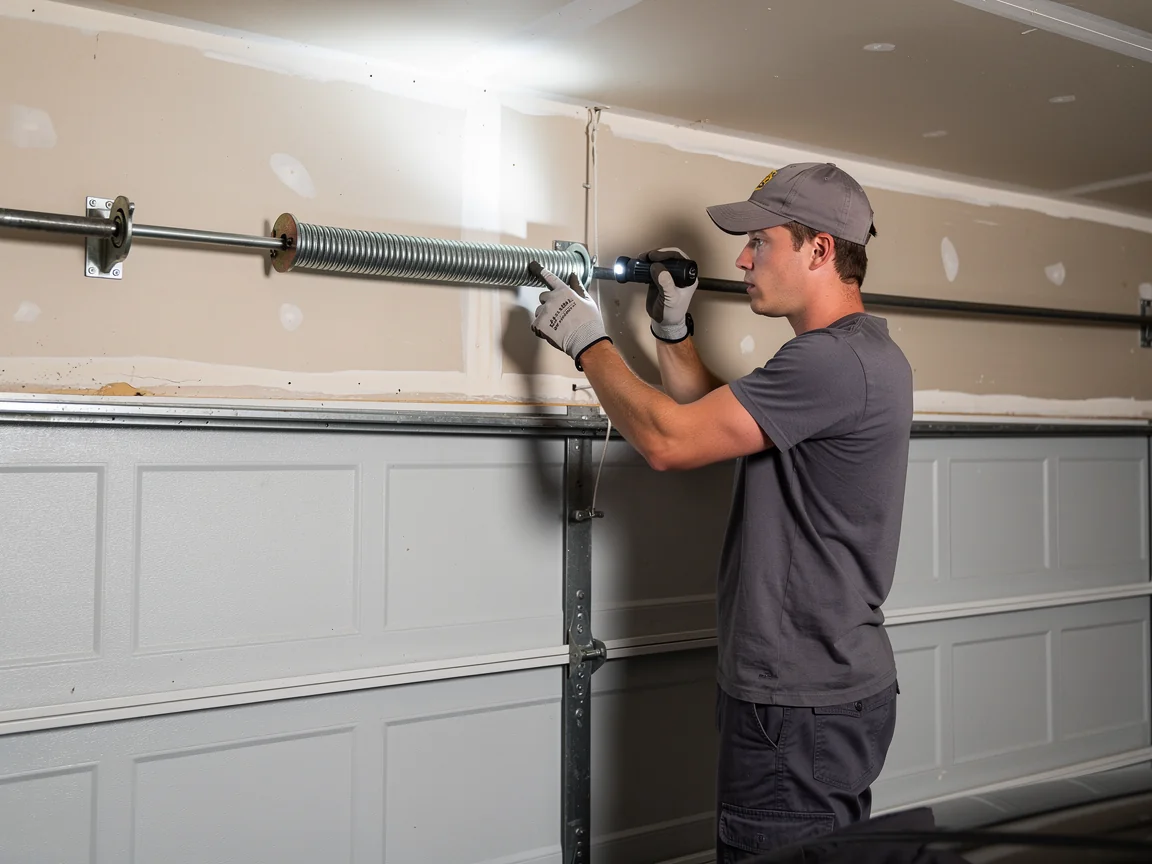
Swapping a roller or tightening loose hardware on the bottom bracket - that's a reasonable DIY job if you're comfortable on a ladder. Springs are not. A wound torsion or extension spring under tension can do real damage if it lets go while you're working on it, and in a COLD severe climate band, cold metal is more brittle and more likely to snap mid-adjustment than it would be in warmer months.
If your door is slow to respond or heavy to lift by hand, that's usually a spring losing tension, not something to diagnose by trial and error. Track alignment is another one best left alone - bending it back by eye usually makes it worse, not better. Lubricating hinges, checking the weatherstripping, and keeping the track clear of debris are fine owner maintenance. Anything involving the spring or the cable drum, call it in.
How It Shows Up
On a lot of East Hartford's 1961-era garages, the first sign is the door getting noticeably heavier to lift by hand over a few weeks - that's spring fatigue, not a sudden failure. Another common pattern: the door reverses partway up on cold mornings, then runs fine once the day warms, which points to a track or roller issue aggravated by the cold rather than the opener itself.
Older single-layer steel panels also show their age as surface rust at the bottom corners, where water sits after rain or snowmelt before it drains. That's cosmetic until the rust works into the seam, at which point it can affect the panel's strength. None of this means panic - it means the door is doing exactly what a 60-year-old door does, and it's worth having someone look at the spring and track together rather than one at a time.
Frequently asked questions
Why does my garage door get so much harder to lift in the winter?
Cold makes steel springs stiffer and the grease in the rollers and hinges thicker, so the whole system works harder to move. On older doors common to East Hartford's 1960s housing stock, a spring that's already lost some tension will show it most in cold weather, which is often when people first notice the problem.
Does Hartford Garage Door Pros have a location in East Hartford?
No. The company works out of Hartford and travels the roughly 4 miles into East Hartford for jobs. There's no local branch or depot here, so quotes and scheduling run through the Hartford office.
Is it cheaper to repair or replace an old garage door?
It depends on what's actually broken. A spring, cable, or roller repair is usually far less than replacement. Given East Hartford's median household income of $66,943, most owners here are better served fixing a sound door than replacing it outright, unless the panels or track are failing too.
My door panel has a crack but the door still opens fine. Do I need a new door?
Not necessarily. If the track, springs, and opener are all working, a single cracked panel can sometimes be matched and replaced on its own. On older 1960s-profile doors that match isn't always in stock, so there can be a short wait on the part.
More garage door services in East Hartford
Book garage door service in Hartford
Call now or request a quote - tell us what the door is doing and where you are.