
Hartford, CT · Garage Door Service
Detached or Attached: Why It Changes the Door You Need in Hartford
Hartford homes built 1938-1986 split sharply between detached garages and attached ones. Here's how that history and the region's cold winters change what a door needs to do.
- Repairs & new doors
- Springs & openers
- Serving 6 nearby communities
Where People Go Wrong
The mistake we see most often is treating a detached garage door and an attached garage door as the same purchase. They're not, and in a city where the housing stock runs 1938 to 1986 with a median build year of 1972, the gap matters more than it would in a newer suburb.
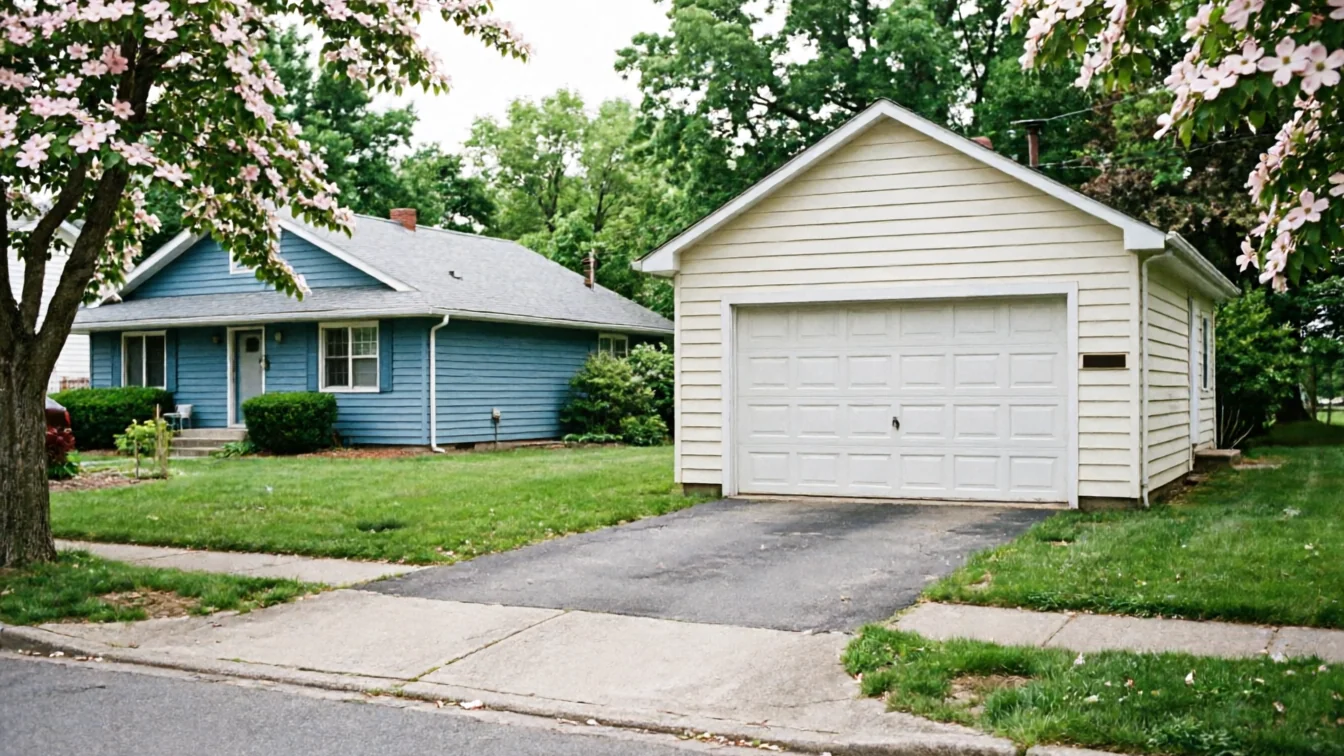
A lot of detached garages around Hartford went up years after the house itself, tacked onto the back of a lot with framing that doesn't match the main structure's wall thickness or stud spacing. When someone orders a standard-width insulated door sized off the house's specs instead of measuring the actual detached opening, it either doesn't fit the jamb or it fits loose enough to rattle and let drafts in.
Attached garages carry a different risk. Because the garage shares a wall with living space, an uninsulated or poorly sealed door doesn't just let cold air sit in the garage - it pulls heat out of the room next to or above it. We've been into attached garages where the door itself was fine but nobody had ever replaced the bottom seal, and the homeowner had no idea that gap was why the mudroom floor stayed cold all winter.
The fix isn't the same for both. Detached garages need a door matched to its own opening and its own exposure. Attached garages need the door treated as part of the house's thermal envelope, not a separate box.
How Local Conditions Play In
Hartford sits in a cold-severe climate band, and that changes the math for each garage type differently. A detached garage gets no benefit from the house at all - no shared wall, no residual heat, nothing holding the air temperature up overnight. On a hard freeze, a detached garage can sit at outdoor temperature or close to it, which is why we see more track ice, stiff rollers, and spring contraction issues on detached doors than on attached ones.
An attached garage runs warmer because it borrows heat through the shared wall, but that same connection means a bad seal costs the homeowner on the heating bill, not just in the garage. With median household income in the service area at $107,494, most owners we talk to are willing to pay for a better door once they understand it's a heating-cost issue and not just a garage issue.
The practical split: if your garage is detached, your priority is hardware that tolerates full cold - springs and cables rated for the swing, rollers that don't gum up when the grease stiffens. If it's attached, your priority is the seal package - bottom astragal, side weatherstrip, and insulation value - because that's what's actually touching your heating bill.
The Situation
Across the 67 named areas we work in, the mix of detached and attached garages tracks pretty closely with when a block was built. The region's housing stock runs 1938 to 1986, and the older end of that range - the Capes and Colonials from the 1940s and 50s - tends to have detached garages added later, often set back from the house with a different driveway angle. The newer end, closer to the 1970s and early 80s, built the garage in as part of the original structure, attached from day one.
With 192,067 owner-occupied houses among 386,561 households in the area, we're not dealing with a small or uniform sample. A two-car attached garage in a 1978 build and a single detached garage behind a 1942 bungalow are both common, and they need different doors for different reasons - not because one neighborhood is nicer than another, but because of what was standard construction practice the decade each was built.
We won't tell you your garage type from a phone call. If you're not sure whether yours counts as attached or detached in the way that matters for door choice - meaning does it share a structural wall with conditioned space - that's worth confirming before you order anything.
Checking It Yourself
A few things you can check without a toolbox. First, stand in the garage and put your hand flat against the wall that borders the house. If it's warm to the touch in winter, you've got an attached garage drawing heat, and your door's seal quality is doing real work on your energy bill. If that wall is exterior brick or siding with no house on the other side, you're detached, and the door's job is holding up against full outdoor exposure.
Second, look at the bottom of the door with a flashlight at night from inside. Daylight showing at the corners means the seal has failed - common on older detached doors where the slab settled slightly over the decades.
Third, check the springs. On a detached garage especially, cold makes steel contract, and a spring that's been marginal for a year will often let go on the first hard cold snap of the season. We won't guess at spring life over the phone - that's something we look at in person, because telling someone their spring has
Frequently asked questions
Does a detached garage need a different kind of door than an attached one?
Not a different category of door, but different priorities. A detached garage gets no heat from the house, so hardware that holds up to full cold - springs, cables, rollers - matters more. An attached garage shares a wall with living space, so the seal and insulation value matter more because they affect your heating bill, not just the garage.
Why does my attached garage door let cold air into the house?
Usually it's the bottom seal or side weatherstripping, not the door panel itself. Because an attached garage shares a wall with conditioned space, any gap around the door pulls heat out of the house. We see this often in homes built in the 1960s and 70s where the original seal has never been replaced.
My detached garage door freezes shut in winter. Is that normal?
It happens, especially on older detached garages with no heat source at all. Track ice and stiff rollers are common once temperatures stay below freezing for stretches. It's not something to ignore - forcing a frozen door can strain the opener or bend the track.
Can you tell me over the phone whether my garage counts as attached or detached for door purposes?
Not reliably. What matters is whether the garage shares a structural wall with conditioned living space, and that's something we need to see in person. A garage can look attached from the driveway and still be thermally separate from the house.
Related garage door services in Hartford
More garage door guides
Book garage door service in Hartford
Call now or request a quote - tell us what the door is doing and where you are.