
Hartford, CT · Garage Door Service
Garage Doors in Hartford's Pre-Insulation Housing Stock
Hartford homes built 1938-1986 often carry garage doors from before insulation rules existed. Here's what that means for cold winters and repair costs.
- Repairs & new doors
- Springs & openers
- Serving 6 nearby communities
Where People Go Wrong
Most calls we get start the same way: a spring snapped, an opener grinding, a panel that won't seal at the bottom. The homeowner wants that one part fixed and moves on. What gets missed is the door itself. Housing in this service area was built mostly between 1938 and 1986, with the median year sitting at 1972 - decades before insulation requirements applied to garage doors the way they do now. A door from that era is often a single layer of steel or wood with no thermal break at all. Replacing a spring on a door like that fixes the spring. It does nothing for the fact that the panel itself was never built to hold heat or resist condensation. People spend money chasing symptoms - a roller here, a cable there - on a door whose core problem is its age and construction, not the part that just failed. The fix that actually holds is recognizing when the door, not the hardware, is the thing working against you. That's not every call. Plenty of these original doors are solid and just need the track reset or a worn roller swapped. But on the ones built in that 1960s-70s wave, patch jobs stop making financial sense fast.
How Local Conditions Play In
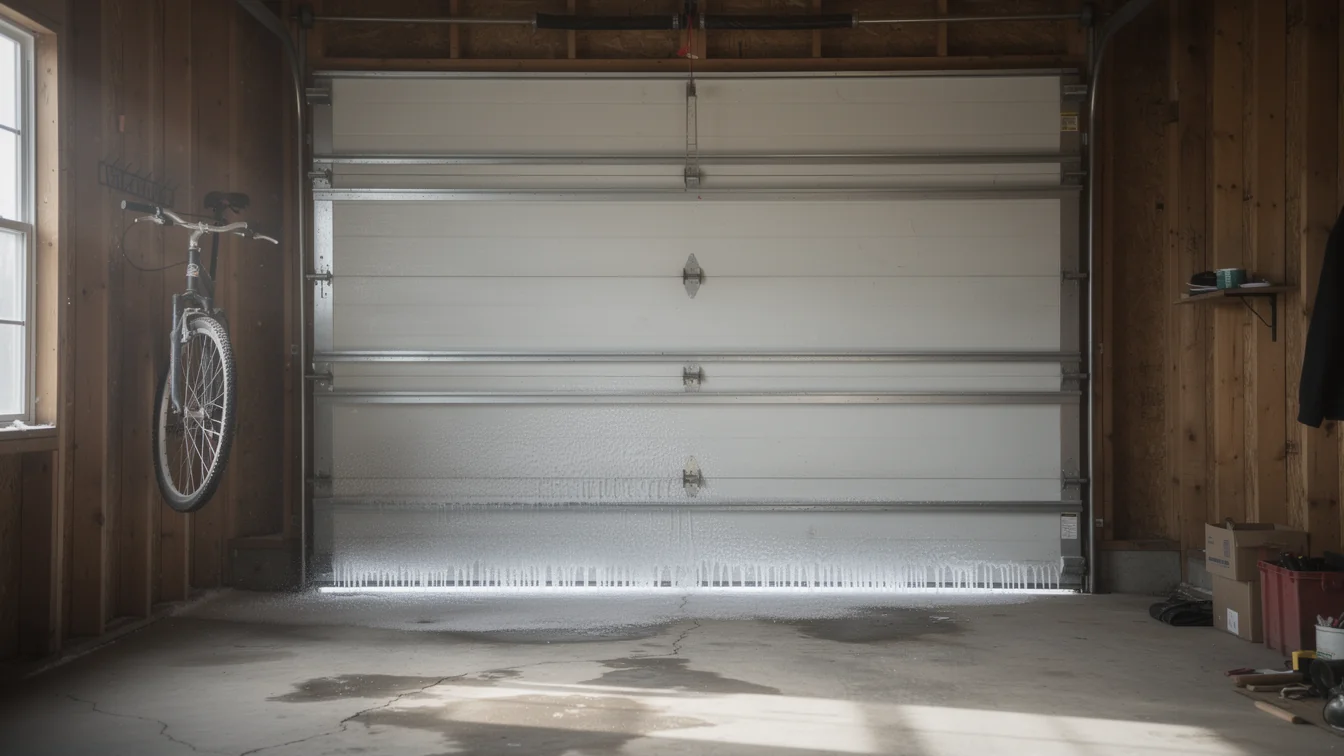
This area sits in a cold-severe climate band, and that matters more on an older door than people expect. An uninsulated steel panel from the 1960s or 70s doesn't just lose heat - it also sweats. Warm garage air hits a cold steel skin and condenses, and over enough winters that moisture works into the bottom seal, the track, and the hardware mounts. Springs and cables sized for a lighter, simpler door from that era also see more cycling stress when cold makes steel brittle and lubricant thick. None of this is dramatic on any single day. It's cumulative - the same door going through the same freeze-thaw pattern every winter for fifty-some years. On a newer insulated door, the sandwich construction buffers a lot of that temperature swing. On the original door, there's nothing between outside and inside except the steel itself. We see the wear show up as rust at the bottom panel seam, stiff rollers that were fine in summer, and openers straining on cold mornings because the door is heavier to move than its specs assume once hardware has stiffened up.
The Situation
The housing stock across this service area isn't uniform in age but it clusters hard: most of the 67 named areas we cover were built out in that same 1938-1986 window, with the heaviest concentration in the 1960s and 70s. That means a lot of garages within a few miles of each other went up using the same door hardware standards, the same torsion spring sizing, and the same lack of insulation requirement. In close-in areas like Downtown, Behind the Rocks, North Meadows, South End, and South Meadows - all within about two miles of the center - you'll find garages built in that same wave sharing the same original door types and the same age-related failure points. Farther out, toward places like West Hartford or Wethersfield, the construction era shifts around but doesn't skip forward much; a lot of it still lands in that same mid-century band. What this means practically: if your neighbor's original door failed at the spring or the bottom panel, yours is on a similar clock, built the same year, under the same weather.
Checking It Yourself
Before you call anyone, a few things you can check. Look at the bottom panel seam for rust bubbling through the paint - that's moisture that's been sitting there a while, a common sign on original uninsulated doors. Put your hand flat against the inside of the door on a cold day; if it's ice cold to the touch and you can feel a draft at the edges, there's no insulation layer doing any work. Check the panels for flex - press gently in the middle of a section. Original steel from this era often has less rigidity than current stock. One honest limitation: we don't do full garage insulation retrofits as a standalone service, and if your door is original from the 1960s or 70s and showing rust through multiple panels, replacement is usually the better money than a repair that buys you another year or two. A torsion spring swap on a door that age is a reasonable call. Patching rot in three panels isn't.
Frequently asked questions
How do I know if my garage door is original to the house?
If your house was built in the window common to this area - 1938 to 1986, with most construction clustered in the 1960s and 70s - and the door has never been replaced, it's likely a single-layer steel or wood panel with no insulation. Rust at the bottom seam, no foam backing visible from inside, and a cold-to-the-touch panel in winter are the usual signs.
Does an uninsulated door matter if I don't use the garage as living space?
It still matters for the house. An uninsulated door in a cold-severe climate lets more cold air sit against anything on the other side of that garage wall, and the condensation cycle on the panel itself speeds up rust and hardware wear regardless of how you use the space.
Is it worth repairing an original door from the 1960s or 70s instead of replacing it?
Depends on what's failing. A spring, cable, or roller on an otherwise sound panel is a fair repair. If the panel itself has rust through in multiple spots or has started to flex and warp, you're paying to delay a replacement that's coming anyway - we'll tell you straight which one you're looking at.
Related garage door services in Hartford
More garage door guides
Book garage door service in Hartford
Call now or request a quote - tell us what the door is doing and where you are.