
Hartford, CT · Garage Door Service
Is Your Hartford Garage Door Worth Fixing, or Is It Time to Replace It
Hartford homes mostly date 1938-1986. Here's how to tell if your original door and hardware are worth repairing or ready for replacement.
- Repairs & new doors
- Springs & openers
- Serving 6 nearby communities
Where People Go Wrong
The mistake we see most in neighborhoods like Behind the Rocks and North Meadows is treating every noisy or stiff door the same way. A door built when the house went up - and most houses around here went up between 1938 and 1986, with the median closer to 1972 - isn't the same animal as a door from 2015. People call a handyman, get a can of spray lube and a new remote battery, and call it fixed. Six weeks later the spring lets go because nobody looked at the actual hardware underneath.
The other common error is replacing a part instead of asking what it's bolted to. A 1960s or '70s door in Hartford often sits on steel track that's been reshaped by decades of New England freeze-thaw, hung from brackets that were never rated for the heavier insulated panels homeowners add later. Swap the opener and leave the track bent, and you've spent money on a problem that was never the opener. We'd rather tell you the track is the issue up front than sell you a motor that papers over it.
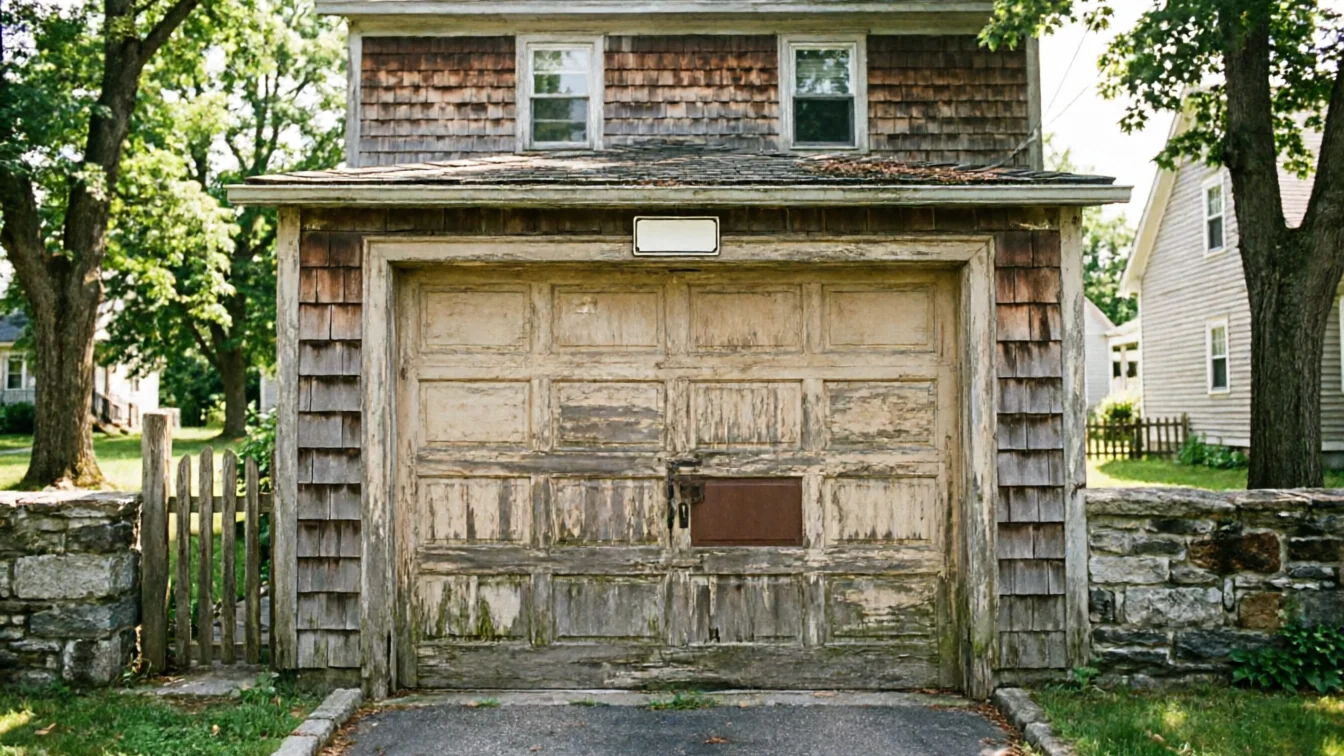
Age alone doesn't mean replace. A door from that era with solid wood or steel panels, sound hardware, and a track that still runs true can often run another decade with the right spring and roller work. The part that actually wears out first is almost never the part people assume.
How Local Conditions Play In
Hartford sits in a cold-severe climate band, and that matters more for a door than most people think. Steel contracts in deep cold, and on an older door - one built to 1970s tolerances, not today's - that contraction shows up as gaps at the bottom seal and binding at the track joints where expansion room was never built in. Torsion springs rated decades ago for a lighter door now carry added insulation panels or a heavier opener bracket, and cold makes brittle metal more likely to snap rather than stretch.
Salt and road grit tracked into garages over a Connecticut winter also eats at cable and roller hardware faster than in a milder climate, which is one reason a 50-year-old door's original hardware is rarely the hardware you should trust going into another winter. None of this means an old door is doomed. It means the inspection has to look at how cold-cycling has actually treated the specific hardware on your door, not just whether it still opens.
The Situation
Across the Hartford area there are roughly 192,067 owner-occupied houses among 386,561 households, and a large share of them carry the same 1960s-70s door stock, whether you're in Downtown, South End, or South Meadows. Median household income here runs around $107,494, which is enough that replacement is a real option for most owners - but that doesn't mean replacement is always the right call.
We look at four things before recommending either path: whether the panels are steel or an older composite that's starting to delaminate, whether the track is original and still straight, whether the spring is sized for the door's current weight, and whether the opener predates modern safety reversal. If three of four check out, repair almost always wins on cost. If the panels are failing and the track's been reshaped by cold, repair becomes a short-term patch, not a fix.
Checking It Yourself
Before you call anyone, stand the door open halfway and let go. A door with a healthy spring stays roughly put; one that drops fast or slams up is telling you the spring's lost tension - common on original torsion springs from the 1960s-70s era that have run through 50-plus Connecticut winters. Look at the bottom panel from inside the garage on a cold morning: daylight around the weatherstrip means the seal has hardened past the point of sealing, which is typical once a door's original vinyl has gone through that many freeze-thaw cycles.
Run your hand along the track for ripples or flat spots - if the door still catches or shudders at the same point every time, that's a bent section, not an opener problem. One honest limitation: we can't tell you over the phone whether your specific door is a repair or a replacement. Panel condition, spring size, and track wear all have to be seen in person, and guessing wrong either wastes your money on parts or talks you into a new door you didn't need.
Frequently asked questions
My garage door is from the 1970s. Is it too old to fix?
Not automatically. If the panels are solid steel, the track is still straight, and the spring is correctly sized, a 1970s door can often be repaired for a fraction of replacement cost. Age matters less than what decades of cold-cycling have actually done to the specific hardware.
Why did my spring snap in winter and not summer?
Cold makes steel more brittle, and Hartford's cold-severe climate puts real stress on torsion springs that are already decades old. A spring weakened by years of tension is more likely to fail outright once temperatures drop, rather than just losing lift gradually.
Is it worth replacing just the track or the whole door?
If the panels are sound and only the track has been bent by cold-cycling or impact, replacing the track alone usually makes sense. We only recommend a full door when panels are failing too - replacing one part to prop up a failing structure is not money well spent.
Related garage door services in Hartford
More garage door guides
Book garage door service in Hartford
Call now or request a quote - tell us what the door is doing and where you are.