
Hartford, CT · Garage Door Service
Why Garage Doors in Hartford Come Off Their Track
Hartford homes built mostly between 1938 and 1986 have steel track and roller hardware prone to slipping after hard winter freeze-thaw cycles. Here's why.
- Repairs & new doors
- Springs & openers
- Serving 6 nearby communities
Where People Go Wrong
The usual mistake is treating a crooked door like a bent-fender problem. Someone sees the panel hanging off-level, grabs a pry bar, and tries to muscle the track back into line, or they crank the opener's force setting up to push the door through whatever is catching. Neither fixes the actual cause.
In a lot of Hartford's housing - built mostly between 1938 and 1986, with a heavy concentration from the 1960s and 70s - the track brackets were lagged straight into wood framing that has had decades to dry, shrink, and shift. A bracket that's pulled even a little loose from the jamb lets the whole rail flex sideways under load. Forcing the door past that flex doesn't reseat anything; it just drags a roller harder against the lip of the track until it jumps.
The other common error is ignoring which spring system the house has. A lot of this older stock still runs extension springs over the horizontal track rather than torsion springs over the header. People search up torsion-spring advice online and apply it to a house with the other setup, which is a good way to get hurt or to miss what's actually wrong. The fix has to match the hardware actually installed, not the hardware that's typical in a newer build.
How Local Conditions Play In
Hartford sits in a severe cold band, and that matters more to a garage track than most people expect. The slab under the garage floor and the foundation it's tied to both go through real freeze-thaw movement every winter. A track that's bolted flush to a door jamb in October can be sitting against a jamb that's heaved or settled by January - sometimes only a fraction of an inch, but that's enough to put the rail out of plumb.
Road salt and sand add a second problem. Cars track grit and brine into the garage all winter, and it lands right at the base of the track and on the bottom rollers. Over a few seasons that grit works into roller bearings and pits the galvanized coating on older track, so rollers that used to ride smooth start binding and skipping instead.
This combination - seasonal foundation movement plus winter road chemicals - hits older track and roller hardware harder than it hits newer composite rollers and heavier-gauge rail. A door that's run fine for years can start acting up the first cold snap after a bracket finally lets go or a roller finally wears through its bearing.
The Situation
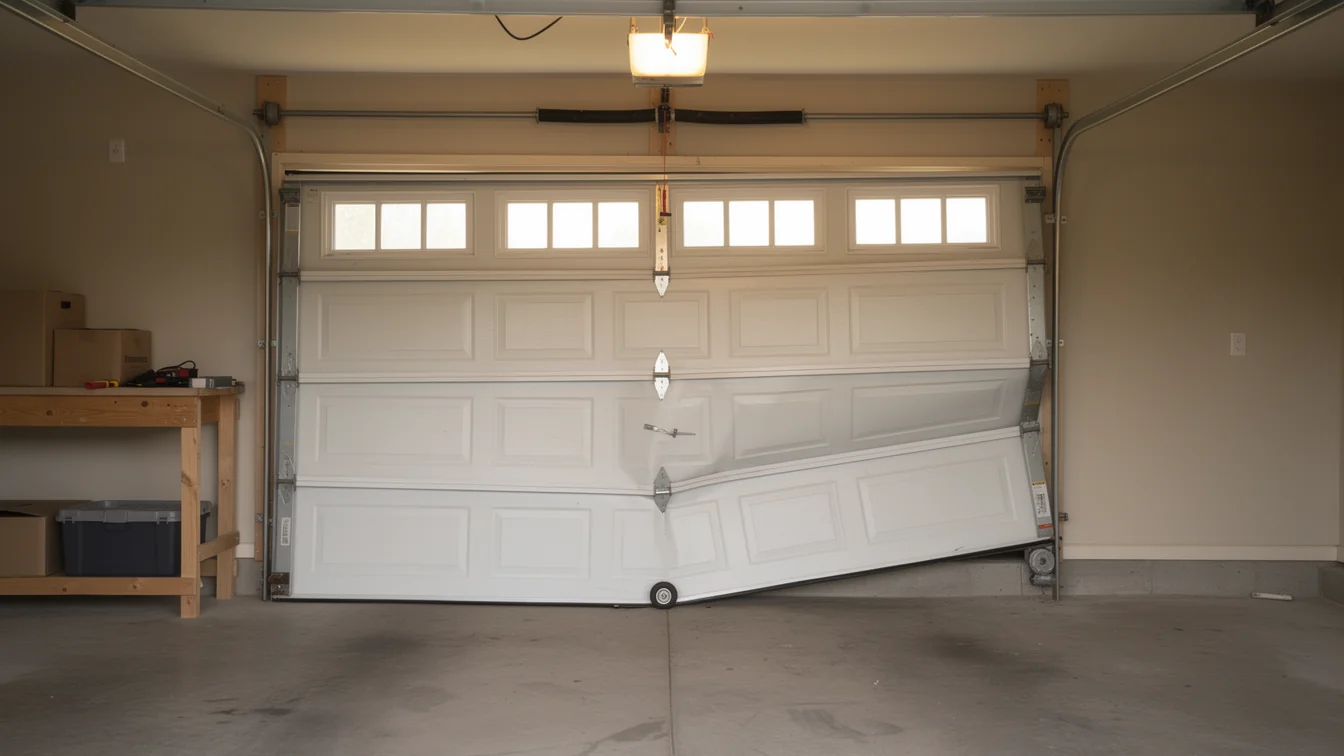
When a door goes off track in a house from this era, it's almost always one of three things. First: a bracket has worked loose from framing that's shifted with the seasons, so the track is no longer sitting plumb against the jamb, and a roller catches the gap at the bottom or top of the rail. Second: a roller itself has worn a flat spot or cracked, which is common once original 1960s and 70s steel track and roller sets pass the decades mark, and the flat spot lets the roller jump the track's lip on its way up or down. Third: a cable has slipped off the drum, usually because a spring or cable fitting that's never been serviced finally stretched or frayed enough to lose tension.
Any of these shows up the same way to a homeowner - the door looks crooked, hangs lower on one side, or stops moving partway with a grinding or popping sound. But the fix is different for each one, and running the opener through it to see if it clears itself usually makes the separation worse, especially if a cable is involved and the door is still under spring tension.
Checking It Yourself
Before you call anyone, a quick look can tell you roughly what you're dealing with. With the door down and the opener disconnected, look along both tracks from front to back for any daylight gap between the rail and the bracket or jamb behind it - that's a loosened bracket. Check each visible roller for flat sides or cracks in the wheel; in a house from the 1960s or 70s original stock, that's often age, not abuse. Look at the bottom corners of the door where the cable runs to the drum - if the cable looks slack or has come off its groove, stop there.
Here's the limit: if a cable is off the drum or a spring looks like it's lost or gained tension, don't try to pull the door back onto the track by hand. That's not a tightening-a-bolt job, it's a job where the door or the spring can move fast and hard. A bent track can sometimes be straightened on site, but if a rail is kinked badly or the bracket holes in the framing have torn out, replacing that section is usually a better use of money than fighting with the original hardware from a sixty-year-old installation.
Frequently asked questions
Why did my garage door suddenly come off track with no warning?
Usually there was warning, just not where you were looking - a bracket working loose or a roller wearing down happens gradually. In Hartford's older housing stock, seasonal freeze-thaw movement in the foundation or framing often finishes the job a worn bracket started, so the failure looks sudden even though the wear built up over seasons.
Is a bent track always a sign I need a new door?
No. A single bent section of track can often be straightened or swapped without touching the door panels. Replacement usually makes more sense when the bracket mounting points in the framing have torn out or when the track is original steel from a much older build and matching parts are hard to source.
Does winter make garage doors go off track more often around here?
Yes, more than people expect. Hartford's cold band brings real freeze-thaw cycling in the slab and foundation, plus road salt and grit tracked in on tires. Both work against older track and roller hardware, which is why off-track calls tend to cluster in the first hard cold stretch of the season.
Related garage door services in Hartford
More garage door guides
Book garage door service in Hartford
Call now or request a quote - tell us what the door is doing and where you are.